The New Industrial Revolution · Part 3 of 3
Where the investable opportunities actually sit in the 2025–2030 window — and what they tell us about where this ends up.

In Part 1 of this series, I argued that the bear case for AI-powered advanced manufacturing is real. But the bear case misses the big near-term opportunity. In Part 2, I outlined the grand vision that we believe: precision, quality-critical manufacturing is already reshoring, and AI is making it pay in ways that weren't possible three years ago. This piece answers the harder question: where, specifically, should investors look?
Let me name the trap first. The most seductive version of this thesis is the integrated thesis — AI design, robotic assembly, and new materials will converge into autonomous factories that make everything better, faster, and cheaper. Over 15 to 20 years, that vision is probably right. As an investment thesis for the next five, it's almost certainly wrong. The near-term winners will be narrower, less glamorous, and far more specific than the full-stack dream.
I say that as someone who made the full-stack bet. At 1Flourish we invested in Prometheus — the company I wrote about in Part 2, building across design, tooling, assembly, and materials at once, backed by Jeff Bezos and co-founded with the scientist Vik Bajaj. I'd defend that check without hesitation. But I'd also be honest about why we wrote it: the integrated bet only clears my bar when the team is genuinely singular, because building the whole stack is the hardest, most capital-intensive path there is. That standard is rare almost by definition. For most of the capital flowing into this space — and for most of where I'm now spending my own time — the more reliable near-term entry points sit one layer down, in the infrastructure the full-stack vision quietly depends on.
Here's where I see the most defensible opportunities in the 2025-to-2030 window.
Author's assessment based on current company deployments, research publications, and a16z portfolio activity. Positions are approximate and will evolve rapidly.
Bet One: Vertical Integration Becomes the Moat
In a growing set of critical sectors, the winning move isn't to sell software into someone else's factory — it's to build the factory itself. When design, materials, robotics, and production all live under one roof and one software system, the vertically integrated factory stops being a cost center and becomes the company's single biggest competitive advantage.
The clearest proof is happening in defense, where the most valuable companies are treating the factory as the product. Anduril is doing exactly this with Arsenal-1, a hyperscale, software-defined plant in Ohio built to mass-produce autonomous systems at a volume and speed traditional primes can't match. The point isn't the building; it's that Anduril designs the product and the production line together, so the factory itself — reconfigurable, software-controlled, vertically integrated — becomes a moat a competitor can't simply buy.
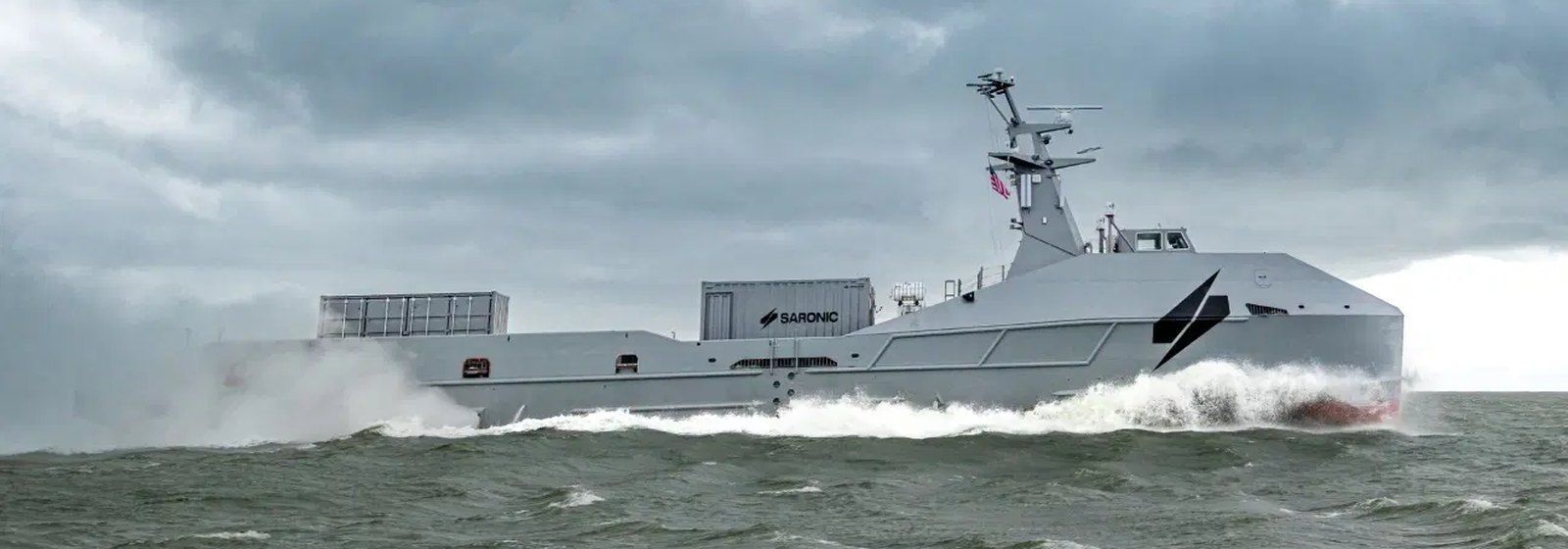
Saronic is running the same play in shipbuilding, with Port Alpha — a more than $3 billion next-generation shipyard in Brownsville, Texas, purpose-built for software-defined, autonomous vessels. Rather than contract production out to a legacy yard, Saronic is building the yard around its own product from the start. In both cases the bet is identical: own the whole stack, and vertically integrated factory production itself becomes the advantage.
This is the harder, more capital-intensive path — you're pouring concrete and buying robots, not just shipping code — and that's precisely why it's defensible. A rival can license the same design tools and the same off-the-shelf robots, but it can't easily replicate a purpose-built factory tuned end-to-end to one product line. In the sectors where speed, volume, and security matter most — defense first, then the industries that follow it — the factory is becoming the flywheel, and the companies that build their own will compound advantages the buyers of someone else's capacity never will.
Bet Two: Closing the Design-to-Manufacturing Gap
AI generative design produces geometrically optimal parts at speed. Manufacturing those parts requires a separate body of expertise — toolpath planning, fixturing, material selection, sequence of operations — that is still largely manual and expert-dependent. The company that automates this translation step owns the bottleneck in the AI manufacturing pipeline.
The clearest example I can point to sits in our own portfolio: ICON. ICON 3D-prints homes and structures — robotic gantry printers extruding its own proprietary concrete, wall by wall — and what makes it a design-to-manufacturing company rather than a construction company is that it owns all three layers at once: a new way to design, a new material, and robotic printing. That trifecta is exactly the integration this category is about, applied to the largest and least-automated manufacturing sector there is: housing.
It's easy to overlook the massive value of ICON's software layer. A 3D-printed home isn't a conventional home built by a machine — it has genuinely different geometry. Curved, rounded walls, which are structurally stronger than the right angles stick-framing forces on you, are natural for a printer and awkward for legacy CAD. So ICON built its own building-design software, because no off-the-shelf tool understood how to design for the printer and the material together. Every home it prints then feeds a growing library of validated, buildable designs — and that library is a real moat by itself.
That's the whole thesis in miniature. The durable value in this category isn't the generative-design flourish that grabs headlines; it's the software that encodes what a specific production process can actually make, plus the proprietary dataset of what has been built and how it performed. ICON has both, and it stays defensible even as the underlying AI design models commoditize — because the library of real, printed, standing structures is something a competitor can't simply download. That's why I think the design-to-manufacturing layer is more defensible than it looks: whoever closes the loop between a design and the machine that builds it owns the bottleneck, and the data compounds from there.
This isn't unique to housing. Saronic — the autonomous shipbuilder from Bet One — runs the same play in steel: it uses its own proprietary design software to improve and accelerate how its vessels are manufactured, closing the loop between design and production the way ICON does for printed structures. Whether the output is a house or a ship, the durable edge is the software that encodes what the process can actually build.
Bet Three: Materials-as-a-Service
AI is radically compressing the discovery phase of materials science. The bottleneck has moved to validation and deployment — taking a promising AI-identified compound through physical testing, certification, and supply-chain development. The company that industrializes that pipeline creates value between two large adjacent markets: materials suppliers and manufacturers.
I keep coming back to ICON here too, because its most durable advantage may not be the printer or the software at all — it may be the concrete. Printing a building means engineering a material that can be pumped out as a paste and then immediately hold its own weight, stacked layer on layer without slumping, and cure to structural strength. That is a materials-science problem at least as much as a robotics one, and it's why ICON runs a deep in-house materials team with multiple PhDs iterating on new, printable, stackable concrete formulations. New forms of concrete engineered specifically to be stacked are the kind of moat a pure software or robotics company can't easily buy.
The purest discovery-to-deployment bet in our portfolio, though, is Cascade Bio. Enzymes are among the most powerful manufacturing tools biology offers, but most of them break down quickly or perform poorly the moment you take them out of a cell — which is exactly why so few make it into industrial production. Cascade's patented approach, which it calls "Body Armor for Enzymes," observes how an enzyme behaves at the molecular level and uses AI/ML to design a stabilizer that dramatically extends the enzyme's useful life and sharpens its targeting, keeping it working across a far wider range of temperature, pH, and solvent conditions and letting it be reused instead of discarded after a single run.
What makes that a discovery-to-deployment bet, rather than just a cost-savings one, is where it leads. The opportunity that most interests me isn't making today's enzyme processes incrementally cheaper — it's making industrially viable enzymes from ones that are currently too fragile for manufacturing, opening entirely new biocatalytic routes to manufacture valuable molecules with biology instead of petrochemistry. That is the definition of bridging discovery to deployment: carrying a promising molecule across the valley of death between a lab result and a process a manufacturer can actually run at scale. ICON and Cascade look nothing alike on the surface, but they're the same bet underneath — that in physical industries, whoever can take a new material from discovery to a deployable, repeatable process captures the most durable value. That's where a meaningful share of my conviction, and our capital, now sits.
| Dimension | Vertical Integration | Design-to-Mfg Software | Materials-as-a-Service |
|---|---|---|---|
| Time to Revenue | 2–4 years | 1–3 years (faster workflow adoption) | 3–5 years (validation timelines) |
| Gross Margin Profile | Hardware-heavy early; improves toward software-like at volume | High (SaaS), but faces commoditization pressure from larger vendors | Mixed: software layer is high-margin; materials production is not |
| Primary Moat | A purpose-built factory rivals can't replicate; speed + volume | Proprietary dataset of design-to-production outcomes | Validated material IP + certification packages |
| Key Risk | Heavy capital intensity; factory execution and ramp risk | Commoditization as CAD/CAM vendors add AI natively | Long validation cycles require patient capital; regulatory surprises |
| Ideal First Customer | DoD / defense buyers needing mass-producible autonomous systems | Defense prime needing DFM for novel components | DoD; manufacturers with high materials costs or reliability issues |
The Bridge to the Big Vision
I'll end with a structural observation rather than a forecast. These three categories aren't substitutes for the full-stack AI manufacturing vision from the first two parts of this series. They're preconditions for it. A company like Prometheus, trying to build across the whole stack at once, is in effect betting it can stand up its own vertically integrated production line, its own design-to-manufacturing loop, and its own materials pipeline internally — because no mature external market for those layers exists yet. That is exactly the gap these three bets fill. Whoever supplies those layers as products makes the next Prometheus cheaper to build, and the one after that cheaper still.
Vertical integration is what makes an AI-native facility compound — own the factory, and the product and the process improve together instead of in isolation. Design-to-Manufacturing software is what limits how fast AI-designed products reach physical production — close that gap and the design advantage becomes actionable. Materials-as-a-Service is what turns AI-discovered materials from lab curiosities into inputs a manufacturer can actually specify and buy.
Each of these builds the capability that makes the next layer of ambition possible. That's not a coincidence — it's the shape of every major technology transition. The enabling layers often come first, and they're frequently where the most durable returns sit. Semiconductors produced more durable wealth through EDA software (Synopsys, Cadence), specialized materials suppliers, and process equipment (ASML, Applied Materials) than through most of the chip designers who depended on them.
The full-stack vision is probably right. The near-term opportunity is owning the layers it depends on — starting with the factory itself, then the software and materials that feed it.
What convinces me the transition is real, not just a narrative, is what I'm seeing from inside both early-stage companies and research environments. The algorithmic work on decision-making under uncertainty in complex physical systems is maturing in ways that haven't shown up in product announcements yet. I get an unusually direct look at this through Valgo, a 1Flourish investment. Its founders come straight out of that lineage — Robert Moss helped build ACAS X, the next-generation airborne collision-avoidance system now being certified as a global standard, and his co-founder Sydney Katz trained in the same Stanford lab, advised by Mykel Kochenderfer, one of the field's foremost authorities on AI safety and validation. Valgo's business is quantifying the risk of autonomous systems — modeling how AI instructs machines, then simulating thousands of edge cases and re-running the whole exercise every time the model updates. That is not a manufacturing company, but it is the same underlying machinery that will govern an autonomous factory floor, and watching it work is a large part of why I don't think these timelines extrapolate in a straight line. The integration of simulation, physical testing, and AI model training is compressing validation cycles faster than the outside view assumes.
None of it is certain. Acemoglu may be right that the productivity gains are smaller and slower than the bulls project. The workforce gap may run deeper than automation can bridge on the relevant timeline. Industrial-policy whiplash may chill the capital investment reshoring needs. These are real risks, and honest investors hold them alongside the thesis.
But the beachhead is real. The technology is maturing. The national-security tailwinds are strong. And the companies building these layers — the vertically integrated factory, the design-to-make software, the materials pipeline — are positioned to capture durable value whether the full-stack vision arrives in 2035, 2040, or later. That's where I'm spending my time. And, so far, my capital.
Part 1 — The bear case is serious, but it's aimed at commodity manufacturing, not precision verticals.
Part 2 — 88% of reshored jobs are already in high-tech sectors. The beachhead is real — and it's why we invested in Prometheus.
Part 3 — The near-term opportunity is owning the layers the full-stack vision depends on: the factory itself, design-to-make software, and materials.
Disclosures: Neil Ahlsten and 1Flourish hold active positions in advanced manufacturing, robotics, and physical-AI companies, including Prometheus, Anduril, Saronic, ICON, Cascade Bio, and Valgo. This series represents his personal analysis and does not constitute investment advice. Additional positions held in stealth are not disclosed.