The New Industrial Revolution · Part 2 of 3
The reshoring data tells a precise story — once you read the right number.

Here's the number everyone cites: 244,000 U.S. manufacturing jobs announced through reshoring and foreign direct investment in 2024 — the second-highest year on record. Since 2010, more than two million such jobs have been announced as companies pull production back toward American customers.
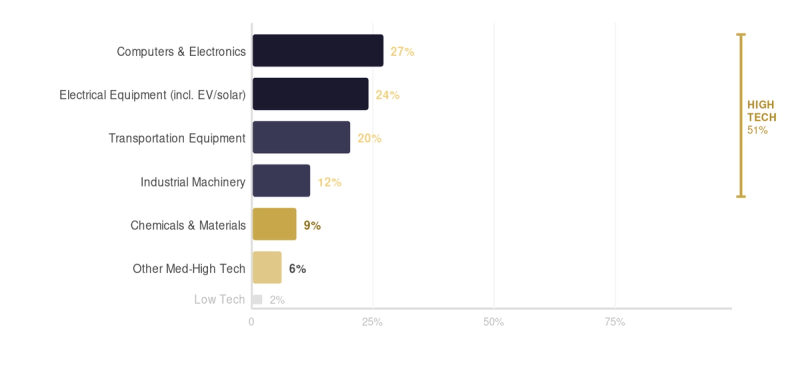
But the headline hides the story. Look at what sits inside that 244,000: 88 percent of those jobs were in high or medium-high technology sectors. Computers and electronics, electrical equipment, transportation components, specialized industrial machinery. Not textiles. Not furniture. Not commodity goods. By early 2025, that share had climbed to 90 percent.
That's the beachhead. It tells you exactly where AI-driven advanced manufacturing is already working — right now, not in 2035. Part 1 argued that the skeptics are aiming at the wrong target. This is the data that proves it: reshoring isn't a commodity story that's failing to materialize. It's a high-tech story that's already underway.
Why High-Tech Reshores First
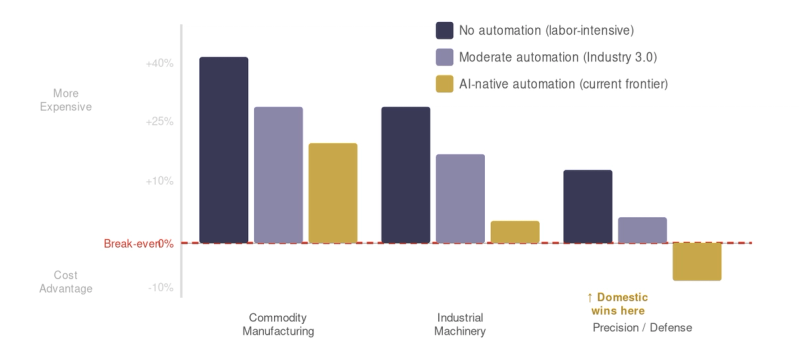
The sectors leading the return share a profile that makes domestic production viable regardless of the labor gap. They're quality-gated — a defect rate that's tolerable in consumer goods is catastrophic in aerospace. They're IP-sensitive — the design of a precision defense component isn't just a trade secret, it's a national security asset. They're supply-chain-critical — the CHIPS Act, the defense industrial base, and ITAR compliance all reward domestic production in ways a pure cost model can't see. And they're increasingly latency-sensitive: going from a changed defense spec to a finished part in days instead of months is an edge only domestic, AI-enabled production can deliver.
That's why 1Flourish invested in Prometheus. The team is the reason. It is rare to see this caliber of scientific and operational talent assemble around hard, physical manufacturing — backed by Jeff Bezos and co-founded with the scientist Vik Bajaj, Prometheus begins from a bench most companies never reach, and it hires against a standard almost no one else can meet. Just as important, it is pointed at exactly the right target: the high-value-add, precision manufacturing that is already happening on American soil and where demand is expanding rapidly. Not commodity volume — the quality-critical work where AI changes the economics, and where the United States has both the need and the edge.
The Chain That's Actually Forming
The detail that gets lost in the breathless coverage of AI and manufacturing is that the convergence isn't arriving all at once. It's forming link by link, starting at design and moving toward assembly. Read that way, the hype separates cleanly from what's real.
Link 1 — AI-augmented design. This is the most mature link. Tools from Autodesk, Siemens, Ansys, Dassault Systèmes, and nTop now use AI to generate, optimize, and validate designs faster than any human team. Generative design produces geometrically optimal parts — lighter, stronger, more material-efficient — in minutes, and NVIDIA's simulation infrastructure runs physics-accurate tests in hours that used to take weeks in a physical lab. This is already in production at major aerospace and defense primes and their tier-1 suppliers.
Link 2 — AI-optimized tooling and process planning. The gap between a design file and a manufacturable part used to demand expensive expertise: how to hold a part, which cutting tools to use, how to sequence operations, how to minimize scrap. AI is automating large portions of it. Machina Labs, for one, is demonstrating AI-controlled metal forming that produces complex shapes without traditional hard tooling. When a part no longer needs a $2 million stamping die, the economics of domestic production change materially.
Link 3 — robotic assembly with increasing generality. This is the least mature link, and the one worth being honest about. Industrial robots aren't new; they've welded car frames since the 1980s. What's new is robots that handle variation — slightly different part orientations, unexpected surface conditions, the real-world messiness rigid automation can't absorb. Physical Intelligence's π0 and π0.5 systems, released in late 2025, show a generalist robot policy adapting to new environments. They're not production-ready at industrial scale yet. But the path from lab to pilot to production is compressing. My read: three to five years to reliable deployment in constrained factory settings.
Link 4 — new materials as the accelerant. This link gets the least attention and may matter most over a decade. AI is compressing the discovery and validation of new materials. Meta's Fundamental AI Research team released the OMat24 dataset — 110 million inorganic materials data points — specifically to accelerate the field, and Microsoft's Azure Quantum Elements pairs AI screening with accelerated quantum chemistry to surface promising compounds. The closed loop a16z's Erin Price-Wright described — predict, simulate, produce, and test with minimal human intervention — is starting to function in the lab. For manufacturing that means parts that are lighter because composites replace metal, stronger because lattice structures replace solid stock, more thermally efficient because new coatings replace legacy treatments.
This is what makes Prometheus compelling: rather than betting on any single link, it is building across all four at once — design, tooling, assembly, and materials. That is the harder path, but it is the only one that actually compresses the loop from concept to finished part, and it is what closing the whole chain requires.
The Beachhead Is a Template
The word is borrowed from military strategy, and it's exact. A beachhead isn't the destination — it's the foothold you expand from. What makes precision manufacturing strategically interesting isn't only that it pays off today. It's that winning here builds the capabilities, the ecosystem, and the institutional knowledge that make broader manufacturing viable later.
Watch what happens when an AI system learns to machine aerospace titanium to tight tolerances, reliably, in a modern U.S. facility. The system accumulates data: which tool paths hold, what failure modes look like, how to catch deviation early, how to adapt when a billet's grain structure drifts from spec. That data doesn't stay in aerospace. It becomes the foundation for the next application — industrial machinery, then automotive components, then things further down the cost curve.
Semiconductors are the clearest precedent. TSMC didn't try to capture every fab application at once. It started in the most demanding process nodes — where process control, quality, and IP protection mattered more than cost per die — and once it owned the capability and the institutional knowledge, expansion followed. AI-enabled precision manufacturing runs the same play. Start where quality beats cost. Build the system. Expand.
The precision beachhead isn't a ceiling — it's a template. Every high-tolerance aerospace part an AI system learns to make becomes training data for everything that follows.
What This Means for the Industrial Stack
The sharpest articulation of this moment comes from a16z's Big Ideas 2026 report on Physical AI and the Industrial Stack, where Erin Price-Wright and her colleagues describe what changes when AI moves off the screen and onto the factory floor. They map an "electro-industrial stack" — minerals refined into components, energy stored in batteries, electricity steered by power electronics, motion delivered through precision motors, all coordinated by software. The key claim is that AI doesn't just optimize one layer; it changes the relationships between layers.
When an AI design tool can optimize a part for performance, weight, and manufacturability at the same time — accounting for the specific machine that will produce it — the old wall between design and manufacturing starts to fall. The designer no longer has to be a manufacturing expert, because the AI carries that knowledge. The manufacturing engineer no longer has to hand-translate design intent into process parameters, because the AI does that too. The result is a faster, tighter loop from concept to physical object, with fewer humans needed at each handoff.
The companies that understand this aren't building point solutions. They're building the integration layer — the software that makes AI-native manufacturing coherent instead of a pile of disconnected tools. That's where I see the most interesting opportunities, and it's exactly where the third piece in this series goes.
The beachhead isn't the whole war. But no one wins the war without taking it first — and America is taking it now.
Reshoring isn't failing to arrive. It's arriving in exactly one place first — and that's the tell.